🇬🇧 FREE UK POSTAGE — DISPATCHED FROM THE UK • 1000+ Happy Customers

Finding flies inside your home can quickly become frustrating. A single fly buzzing around the kitchen may be annoying, while repeated fly activity can indicate that something is attracting insects into the property.
So, what is the best way to get rid of flies indoors?
There isn’t one solution that works perfectly for every situation. The most effective approach usually combines prevention, cleanliness, identifying where flies are coming from, and choosing an appropriate fly-control product.
Depending on the circumstances, options can include a traditional fly swatter, electric fly swatter, fly zapper, or a fly shooter salt gun.
This guide explains the different approaches and how to decide which option may be most suitable for your home.
Why Do Flies Come Inside?
Before choosing a fly-control product, it helps to understand why flies are entering your home.
Flies are attracted to potential sources of food, organic material, waste, and moisture. Kitchens and areas around rubbish bins can therefore be particularly attractive.
Common reasons for indoor fly activity include:
- Food left uncovered
- Food spills or crumbs
- Household waste
- Overripe fruit
- Dirty bins
- Pet food
- Organic material around outdoor areas
- Open doors and windows
- Gaps around windows or doors
If flies keep returning, simply removing individual insects may not solve the underlying problem.
The first step should be to identify and reduce whatever is attracting them.
1. Keep Food Covered
One of the simplest ways to reduce fly activity is to limit access to food.
Keep prepared food covered and store ingredients appropriately. Clean up spills and crumbs promptly, particularly around kitchen worktops, floors, tables, and dining areas.
Fruit can also attract flies as it becomes overripe, so check fruit bowls regularly and dispose of spoiled produce.
Small changes in kitchen hygiene can make your home less attractive to flies.
2. Keep Bins Clean
Household rubbish can be an attractive source for flies.
Use bins with properly fitting lids where possible and empty them regularly. Clean the inside of bins when necessary, especially if food waste or liquids have leaked.
Outdoor bins should also be kept as clean as practical and positioned appropriately.
Reducing access to waste can help prevent flies from gathering around the property in the first place.
3. Check Doors and Windows
Open doors and windows can provide an easy route for flies to enter.
If you regularly notice flies around particular windows or doors, consider whether there are gaps or whether insect screens could help reduce entry.
You don’t necessarily need to keep every window closed. Instead, consider how you can improve ventilation while reducing opportunities for insects to enter.
4. Use a Traditional Fly Swatter
A traditional fly swatter remains one of the simplest options for dealing with an individual fly.
It requires no batteries, charging, or electrical components. You simply use it when a fly appears.
The disadvantage is that you need to get close enough to the insect and have reasonable timing and accuracy.
For occasional fly activity, however, simplicity can be an advantage.
5. Consider an Electric Fly Swatter
An electric fly swatter offers a modern alternative to a traditional swatter.
Instead of relying on a solid paddle, it uses an electrically charged mesh. When the fly comes into contact with the activated mesh, the electrical system can eliminate the insect.
One of its biggest advantages is portability. You can keep an electric swatter in a kitchen, utility room, bedroom, conservatory, or another suitable area and use it when required.
An electric fly swatter may therefore be particularly useful if you occasionally have individual flies indoors and want a targeted solution.
What Are the Benefits of an Electric Fly Swatter?
Depending on the model, benefits can include:
- Portable handheld design
- Reusable operation
- No aerosol spray
- Convenient targeting
- Easy storage
- Suitable for moving between rooms
Always follow the manufacturer’s safety instructions and keep electrical fly swatters away from children, pets, and water unless the product is specifically designed for those conditions.
6. Try a Fly Zapper
A fly zapper takes a different approach.
Instead of being handheld, a fly zapper is normally positioned in a fixed location. Many models use light to attract flying insects toward an electrical grid.
When an insect reaches the grid, the electrical system can eliminate it.
This makes a fly zapper a more passive option. You don’t need to chase individual flies around the room; the device remains in position and operates according to its design.
A fly zapper can be worth considering if you regularly notice flying insects in a particular area.
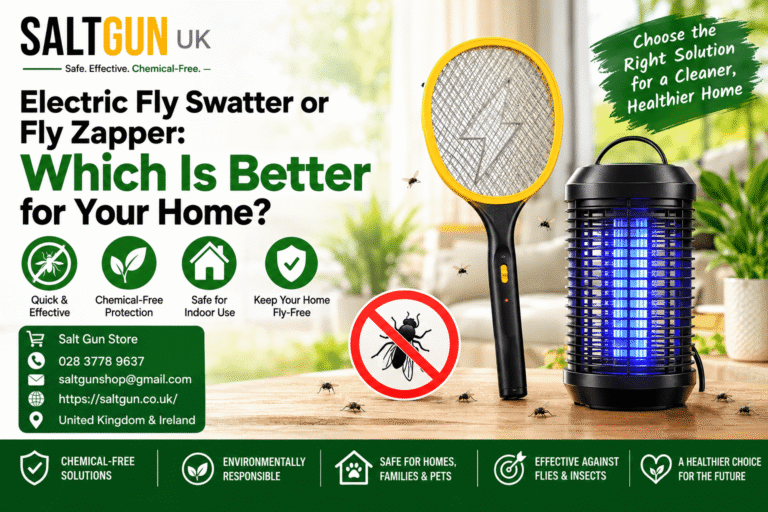
Electric Fly Swatter vs Fly Zapper
If you’re unsure which option to choose, consider how frequently you encounter flies.
| Feature | Electric Fly Swatter | Fly Zapper |
| Design | Handheld | Stationary |
| Approach | Active | More passive |
| Portability | High | Limited |
| Best for | Individual flies | Repeated activity |
| User involvement | Direct targeting | Minimal after setup |
| Storage | Easy | Requires suitable location |
If you see one or two flies occasionally, an electric swatter may be more convenient.
If you frequently experience flies in a particular room, a fly zapper may offer a more hands-off approach.
7. What About a Salt Gun for Flies?
A fly shooter salt gun is another option for people looking for a reusable way to target individual flies.
Rather than using an insecticide spray, suitable salt guns use a burst of ordinary salt propelled through a mechanical firing system.
The concept is straightforward: load suitable dry salt, prepare the device according to its instructions, aim at the fly from an appropriate distance, and fire.
Salt guns are intended for close-range targeting and should always be handled responsibly. Never aim one at people, pets, or animals, and be aware of what is behind the target.
For shoppers interested in this type of fly-control product, Salt Gun Store provides an option to explore salt-powered solutions alongside other fly-control choices.
Which Fly-Control Method Is Best?
The best option depends on the circumstances.
For one occasional fly
A traditional or electric fly swatter may be sufficient.
For several flies in a specific room
An electric fly swatter or appropriately positioned fly zapper may be more convenient.
For people seeking an alternative to aerosol sprays
An electric fly swatter or suitable salt gun can provide non-aerosol alternatives for dealing with individual flies.
For repeated or large-scale fly activity
Don’t rely exclusively on a fly-control device. Investigate where the flies are coming from and what is attracting them.
If there is a persistent infestation, professional pest-control advice may be appropriate.
How to Stop Flies From Coming Back
Getting rid of the flies you can see is only part of the solution.
To reduce future activity, focus on prevention.
Keep kitchen surfaces clean and remove food waste promptly. Store food properly and don’t leave uncovered leftovers sitting out for extended periods.
Clean bins regularly and inspect areas where rubbish or organic material may accumulate.
You should also check potential entry points around windows, doors, vents, and other openings.
If flies are consistently appearing despite good hygiene and preventative measures, look for a less obvious source.
Getting Rid of Flies in Different Areas of the Home
Kitchen
The kitchen is often the first place to investigate because food and waste can attract flies. Keep worktops clean, cover food, and empty rubbish regularly.
An electric fly swatter can be convenient for dealing with individual flies when they appear.
Dining Area
Keep food covered and clean spills immediately. A fly-control device can be useful when flies repeatedly disturb meals.
Conservatory
Warm, bright spaces can become attractive to flying insects. Check doors and windows for possible entry points and consider a suitable fly-control product.
Garage or Utility Room
Check bins, stored food, organic material, and other potential attractants. A fixed fly-control solution may be useful where activity is recurring.
Fly Control Across Newry and Surrounding Areas
People looking for ways to control flies may be searching for solutions across Newry, Keady, Monaghan, Dundalk, Banbridge, Dungannon, Cookstown, Craigavon, Portadown, and Lurgan.
The same basic principles apply regardless of location: reduce attractants, limit entry points, maintain good hygiene, and choose a fly-control method appropriate for the level of activity.
For shoppers comparing electric fly swatters, fly zappers, and other fly-control products, Salt Gun Store can be considered when researching reusable options for dealing with individual flies.
When Should You Consider Professional Pest Control?
Occasional flies are generally different from a persistent infestation.
If you’re repeatedly finding large numbers of flies, seeing them emerge from a particular area, or noticing fly activity despite thorough cleaning and preventative measures, there may be an underlying source that needs investigation.
In such situations, a household fly-control product may only address the visible insects rather than the source.
Professional pest-control advice can help identify and address persistent infestations.
Final Thoughts
So, what is the best way to get rid of flies indoors?
The answer is usually a combination of prevention and appropriate fly control.
Start by removing food sources, keeping rubbish contained, cleaning surfaces, and reducing potential entry points. Then choose a solution based on the type and frequency of fly activity.
For occasional flies, a traditional or electric fly swatter can provide a simple targeted solution. For repeated activity in one area, a fly zapper may offer a more hands-off approach. A suitable salt gun for flies can also appeal to people looking for a reusable alternative to conventional aerosol sprays.
The most important thing is to choose a solution that matches your home and your particular fly problem rather than assuming that one product is best for everyone.
Whether you’re in Newry, Keady, Monaghan, Dundalk, Banbridge, Dungannon, Cookstown, Craigavon, Portadown, or Lurgan, good fly control starts with understanding why flies are entering your home and then combining prevention with the right practical solution. For those researching reusable fly-control products, Salt Gun Store offers another option to consider when comparing solutions for individual indoor flies.
Frequently Asked Questions
What is the best way to get rid of flies indoors?
The best approach is usually a combination of prevention and fly control. Keep food covered, clean spills quickly, empty rubbish regularly, reduce potential entry points, and use an appropriate fly-control product such as an electric fly swatter or fly zapper when necessary.
How do I get rid of flies in my kitchen?
Start by removing food sources and cleaning kitchen surfaces thoroughly. Keep fruit and food covered, empty bins regularly, and clean up spills and crumbs. An electric fly swatter can also be useful for dealing with individual flies.
Do electric fly swatters work on house flies?
Electric fly swatters are designed to target flying insects using an electrically charged mesh. When a fly comes into contact with the activated mesh, the electrical system can eliminate it. Always follow the manufacturer’s instructions when using one.
Are fly zappers effective indoors?
A fly zapper can be useful for dealing with flying insects in a suitable indoor location. Many models attract insects using light before they reach an electrical grid. Effectiveness depends on the product, placement, environment, and level of insect activity.
What is the difference between an electric fly swatter and a fly zapper?
An electric fly swatter is a handheld device that you actively use to target individual flies. A fly zapper is generally stationary and designed to attract flying insects to the device. An electric swatter is more portable, while a zapper provides a more hands-off approach.
Is a salt gun a good way to get rid of flies?
A suitable fly shooter salt gun can be an option for targeting individual flies at close range. It uses a mechanical system to propel salt rather than conventional insecticide spray. It should always be used responsibly and according to the manufacturer’s safety instructions.
How can I stop flies from coming into my house?
Keep food covered, clean food spills promptly, empty rubbish regularly, keep bins clean, store food properly, and check doors and windows for possible entry points. Reducing the things that attract flies is an important part of long-term fly control.
Why do I keep getting flies in my house?
Repeated fly activity can be caused by accessible food, rubbish, organic material, moisture, or easy entry points around doors and windows. If large numbers of flies continue appearing despite cleaning and prevention, there may be an underlying source that requires further investigation.
Are electric fly swatters safe around children and pets?
Electric fly swatters should be handled responsibly and kept away from children and pets. Never allow anyone to touch the electrical mesh while the device is activated, and follow the manufacturer’s safety instructions.
Where can I buy fly-control products in Ireland?
When choosing a fly-control product, compare the type of device, intended use, safety instructions, power requirements, portability, and maintenance requirements. Customers in areas such as Newry, Keady, Monaghan, Dundalk, Banbridge, Dungannon, Cookstown, Craigavon, Portadown, and Lurgan can research suitable options based on their individual needs.