
🇬🇧 FREE UK POSTAGE — DISPATCHED FROM THE UK • 1000+ Happy Customers

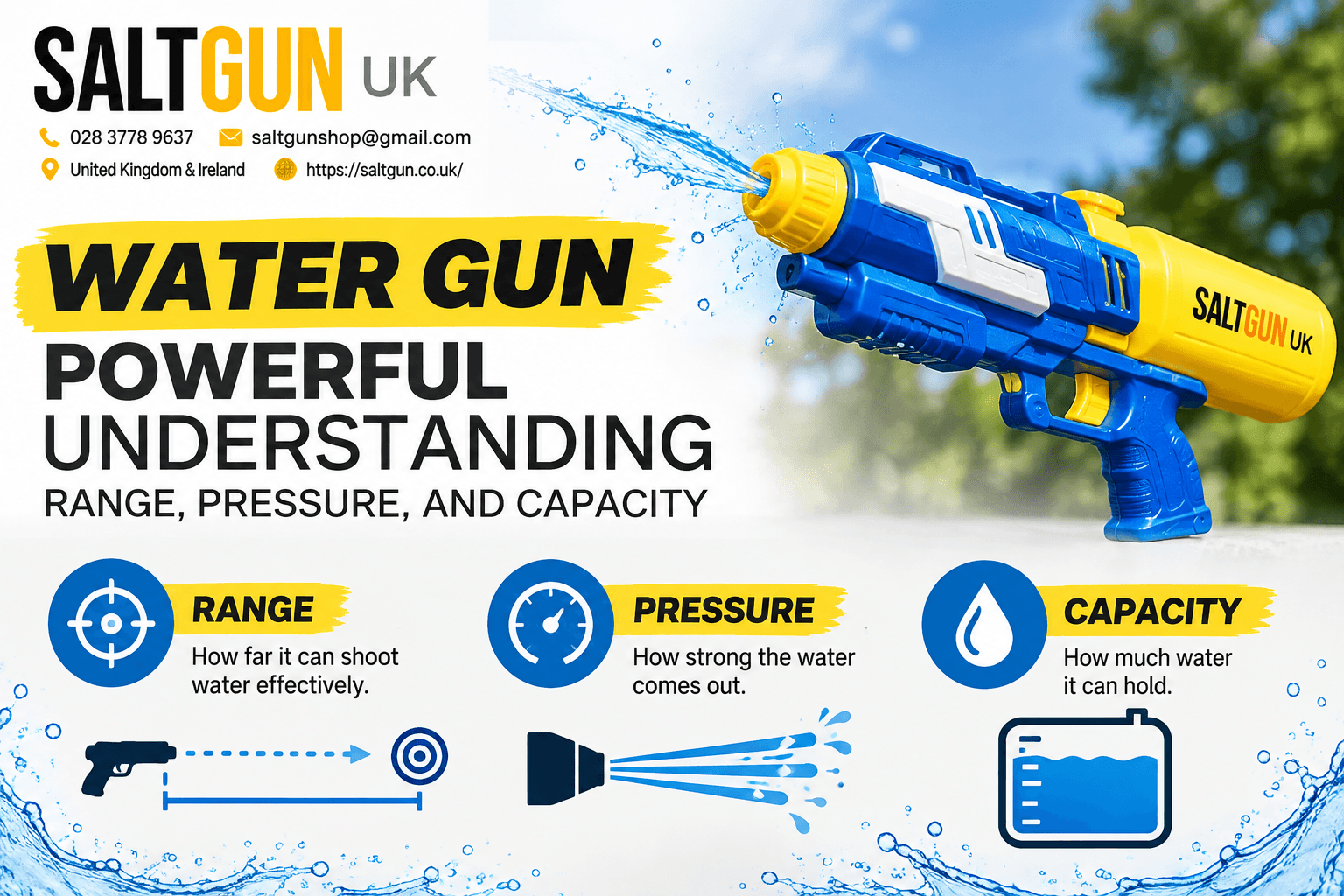
Not all water guns perform in the same way. Some produce a short stream of water, while others can send water much farther with a stronger and more consistent spray. If you’re looking for a powerful water gun, understanding what actually creates that performance can help you choose a model that matches your needs.
Terms such as range, pressure, capacity, battery power, nozzle design, and water flow are often used when describing modern electric water guns. But what do these features really mean?
Whether you’re looking for an electric water gun for summer games, outdoor activities, family fun, or simply want to understand how these products work, this guide explains the key factors that determine water-gun performance.
What Makes a Water Gun Powerful?
A water gun’s performance is influenced by several components working together. The most important factors are:
- Water pressure
- Shooting range
- Water flow
- Tank capacity
- Pump or motor performance
- Nozzle design
- Battery capacity in rechargeable models
- Overall construction
A product isn’t necessarily powerful simply because it has a large water tank. Similarly, a long advertised range doesn’t always mean the water stream will remain equally strong at maximum distance.
Understanding how these features interact gives you a better way to compare different models.
1. Water Pressure
Water pressure is one of the most important factors affecting how strongly water leaves the gun.
A higher-pressure system can produce a faster and more forceful stream, potentially allowing the water to travel farther.
In traditional water guns, pressure may be created manually by a piston or pump mechanism. Modern electric water guns can use a motorised pumping system to move water through the device.
However, more pressure isn’t automatically better in every situation. The ideal performance depends on how you intend to use the water gun.
For casual backyard games, moderate pressure may be perfectly adequate. If you’re looking for a more powerful outdoor water gun, pressure becomes a more important specification to compare.
2. Shooting Range
Range refers to how far the water stream can travel under suitable conditions.
A powerful water gun with a well-designed pumping system and nozzle can potentially deliver a stream farther than a basic model.
However, advertised range should be viewed as a guide rather than a guarantee. Real-world performance can be affected by:
- Wind
- Nozzle setting
- Battery level
- Water level
- Angle of the water gun
- Pump performance
- How continuously the device is being used
For this reason, don’t judge a water gun solely by its maximum stated range. Look at range alongside pressure and water-flow characteristics.
3. Water Flow
Water flow describes how much water the device can deliver over a given period.
A water gun with a strong but relatively narrow stream may feel very different from one that releases a larger volume of water over a wider area.
The right balance depends on what you’re looking for.
If you want a precise stream that travels a longer distance, nozzle design and pressure may be particularly important. If you’re playing close-range water games, a higher-volume spray may be more useful.
This is why powerful water gun shouldn’t be interpreted as a single specification. Performance comes from several components working together.
4. Tank Capacity
Tank capacity determines how much water the water gun can hold before it needs to be refilled.
A larger tank can be convenient because you don’t have to refill the device as frequently. This can be particularly useful during longer outdoor games.
However, there is a trade-off.
A larger tank can also make the water gun heavier, especially once it is filled. A smaller tank may be easier to carry and handle but may require more frequent refills.
When comparing water guns, consider your preferred balance between capacity, weight, portability, and play time.
5. Motor and Pump Performance
Electric water guns rely on a motorised system to move water through the device. The pump is responsible for creating the flow of water, while the motor provides the energy required for operation.
A well-designed motor and pump system can contribute to:
- Consistent water flow
- Improved stream performance
- Easier operation
- Reduced need for manual pumping
- More convenient continuous use
This is one reason electric water guns can feel significantly different from traditional manually operated models.
When choosing a rechargeable electric water gun, it’s worth considering the overall design rather than focusing on one specification in isolation.
6. Nozzle Design
The nozzle controls how water leaves the gun.
A narrow nozzle can create a more concentrated stream, while a wider opening can produce a broader spray. Some models may offer different spray patterns or adjustable settings.
Nozzle design can therefore influence both perceived power and range.
For example, a concentrated stream may be useful when you want to reach a specific target from farther away. A wider spray can be more suitable for close-range games where covering a larger area is more important.
7. Battery Power in Rechargeable Water Guns
For a rechargeable water gun, battery performance is another important consideration.
An electric water gun needs sufficient battery power to operate its motor and pumping system. As the battery becomes depleted, performance may change depending on the design of the product.
When comparing rechargeable models, look beyond the simple fact that a battery is included. Consider:
- Charging time
- Expected operating time
- Charging method
- Battery capacity
- Whether the battery is integrated or removable
- Manufacturer charging instructions
A powerful electric water gun is only useful if its battery provides enough operating time for the way you plan to use it.
Electric vs Traditional Water Guns
Traditional water guns generally rely on manual pumping or squeezing mechanisms. They can be simple, lightweight, and easy to operate.
Electric water guns use a motorised mechanism to assist with water delivery.
The main difference is convenience and operation.
An electric model can provide a more automated experience, while a traditional model may appeal to people who prefer simplicity and don’t want to charge a battery.
Neither type is automatically better. Your choice depends on your preferred experience, budget, intended use, and the features you value most.
What Should You Look for in a Powerful Electric Water Gun?
If you’re shopping for a powerful electric water gun in the UK, consider these features together:
Range
Look for a model with a range appropriate for your intended outdoor games.
Pressure and Stream
Consider whether you prefer a concentrated stream or a broader water spray.
Capacity
A larger tank can mean fewer refills, but it can also increase the overall weight when filled.
Battery
Check charging requirements and expected operating time.
Weight
Remember that the water gun becomes heavier after filling the tank.
Ergonomics
A comfortable grip and easy-to-use controls can make a significant difference during longer periods of use.
Build Quality
Outdoor games can be demanding on equipment, so durable construction can be an important consideration.
Where Can a Powerful Water Gun Be Used?
Powerful electric water guns are primarily associated with outdoor recreational use. Gardens, parks, outdoor gatherings, and suitable private spaces can provide opportunities for water-based games.
Always consider your surroundings and use water guns responsibly. Avoid aiming at people who don’t want to participate, animals, electrical equipment, roads, or areas where wet surfaces could create a safety hazard.
If you’re purchasing a rechargeable water gun in the UK, also check the manufacturer’s recommendations regarding charging, storage, water use, and maintenance.
Choosing a Water Gun in Newry and Surrounding Areas
Customers searching for electric and rechargeable water guns may be looking across a wide area, including Newry, Keady, Banbridge, Dungannon, Cookstown, Craigavon, Portadown, and Lurgan.
Interest can also extend across the border into Monaghan and Dundalk, where shoppers may be comparing different options for outdoor games and summer activities.
Rather than choosing a product based only on the word “powerful,” consider how the specifications match your intended use. A long-range model may suit one person, while another may prefer a lightweight rechargeable model with a larger tank.
Salt Gun Store can be considered when comparing electric and rechargeable water-gun options and looking for a model that balances performance, capacity, portability, and convenience.
How to Get the Best Performance From Your Water Gun
Even a powerful water gun needs to be used correctly.
Start by filling the tank according to the manufacturer’s instructions. Make sure the battery is adequately charged if you’re using a rechargeable electric model.
Keep the nozzle clean and check the device regularly for blockages or damage. Store the water gun appropriately after use and follow the manufacturer’s recommendations for cleaning and storage.
It’s also worth remembering that environmental conditions matter. Wind can significantly affect the direction and range of a water stream, so performance outdoors can differ from controlled product testing.
Is a Bigger Water Tank Better?
Not necessarily.
A large tank provides more water between refills, but it also adds weight. For younger users or people who value portability, a smaller and lighter water gun may be more comfortable.
Think about how long you expect to use the product and how frequently you will have access to a convenient water source.
For extended games, capacity can be valuable. For short games or easy portability, a smaller tank may be preferable.
Final Thoughts
So, what makes a water gun powerful?
There isn’t one single answer. Water pressure, pump performance, nozzle design, water flow, shooting range, tank capacity, and battery performance can all influence the overall experience.
If you’re looking for a powerful electric water gun, compare these features as a complete package rather than focusing on one headline specification.
For shoppers in Newry, Keady, Monaghan, Dundalk, Banbridge, Dungannon, Cookstown, Craigavon, Portadown, Lurgan, and surrounding areas, understanding these specifications can make it easier to choose a rechargeable or electric water gun that fits your outdoor activities.
The best water gun isn’t necessarily the one with the biggest tank or the highest advertised range. It’s the one that provides the right combination of power, range, capacity, battery performance, comfort, and usability for how you intend to use it.
Salt Gun Store offers a useful starting point for shoppers comparing water-gun options and looking for a balance between performance and practical everyday use.
Frequently Asked Questions
What makes a water gun powerful?
A water gun’s power is influenced by its water pressure, pump or motor performance, nozzle design, water flow, and overall construction. In rechargeable electric models, battery performance can also affect how consistently the device operates.
What is the difference between water pressure and water-gun range?
Water pressure relates to the force with which water is pushed through the system, while range describes how far the resulting water stream can travel. Pressure, nozzle design, water flow, and environmental conditions can all affect the final range.
Are electric water guns more powerful than traditional water guns?
Electric water guns can provide a more automated and consistent water stream because they use a motorised pumping system. However, performance varies between individual models, so an electric design isn’t automatically more powerful than every traditional water gun.
Is a larger water tank better?
A larger water tank can reduce the number of refills needed during outdoor games, but it also makes the water gun heavier when full. The ideal capacity depends on how long you plan to use it and how important portability is to you.
How far can a powerful water gun shoot?
The range varies significantly between models. Manufacturer specifications can provide an estimated maximum range, but real-world performance may be affected by wind, water level, battery charge, nozzle design, and the angle of the water gun.
How does a rechargeable water gun work?
A rechargeable water gun uses a battery to power a motor and pumping mechanism that moves water through the device. Once the battery is depleted, it can be recharged according to the manufacturer’s instructions.
What should I look for in a powerful electric water gun?
Consider range, water pressure, flow, tank capacity, battery life, charging time, weight, nozzle design, comfort, and build quality. Comparing these features together can give you a better idea of whether a model suits your intended use.
Are powerful electric water guns suitable for children?
Suitability depends on the specific product, its design, and the manufacturer’s recommended age. Always follow the manufacturer’s instructions and supervise children where appropriate. Water guns should be used responsibly and never aimed at faces, animals, electrical equipment, or unwilling participants.
Where can I buy a rechargeable water gun in the UK?
When choosing a rechargeable water gun in the UK, compare specifications such as battery performance, tank capacity, range, nozzle design, and overall construction. Shoppers in areas including Newry, Banbridge, Craigavon, Portadown, Lurgan, Dungannon, Cookstown, Keady, Monaghan, and Dundalk can compare available options based on their requirements.