🇬🇧 FREE UK POSTAGE — DISPATCHED FROM THE UK • 1000+ Happy Customers

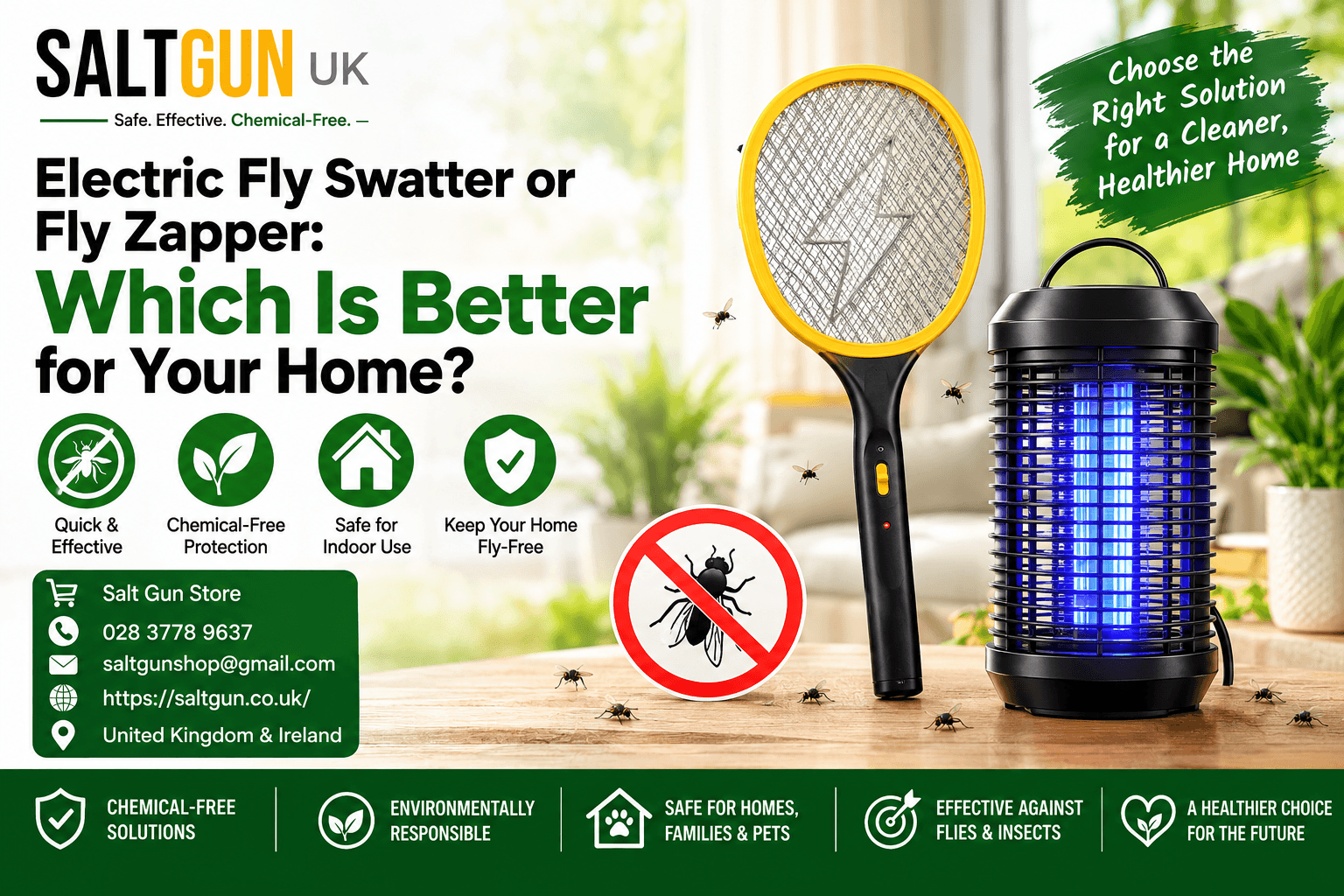
Flies can quickly become an unwanted problem in homes, kitchens, gardens, garages, and outdoor spaces. While a traditional fly swatter can work for an occasional fly, many people look for a faster and more convenient solution when dealing with repeated fly activity.
Two popular options are electric fly swatters and fly zappers. But which one is better for your home?
The answer depends on where you have a fly problem, how frequently flies appear, and whether you want a hands-on solution or something that can operate in the background.
In this guide, we compare electric fly swatters and fly zappers, explain how each works, and help you decide which option may be more suitable for your needs.
What Is an Electric Fly Swatter?
An electric fly swatter is a handheld device designed to help deal with flies and other small flying insects. It resembles a traditional fly swatter but includes an electrically charged mesh.
When a fly comes into contact with the activated mesh, the electrical charge can eliminate the insect.
The main advantage is control. Instead of waiting for insects to approach a fixed device, you can move the electric swatter around the room and target individual flies.
This makes an electric fly swatter particularly useful when you notice a fly moving around a kitchen, living room, bedroom, conservatory, or other indoor area.
Benefits of an Electric Fly Swatter
Some of the main advantages include:
- Portable design: You can carry it from room to room.
- Direct control: You decide which insects to target.
- Convenient for occasional flies: It is useful when only a few flies are present.
- No chemical sprays: It provides an alternative to conventional insect sprays.
- Easy storage: Most models can be stored in a cupboard or utility area when not required.
For households that want a quick, targeted method of dealing with individual flies, an electric fly swatter can be a practical choice.
What Is a Fly Zapper?
A fly zapper works differently. Rather than being handheld, it is generally designed to remain in a fixed position.
Many fly zappers use light to attract flying insects toward the device. When an insect reaches the internal electrical grid, it is eliminated.
Because the device remains in one location, it can provide a more passive approach to fly control.
Instead of chasing individual flies around the room, you can position the zapper in a suitable area and allow it to work when insects approach.
Electric Fly Swatter vs Fly Zapper: What’s the Difference?
The biggest difference is how you use them.
An electric fly swatter is an active solution. You see a fly, pick up the device, and attempt to target it.
A fly zapper is generally a passive solution. You position it in an appropriate location and let it attract insects.
Here’s a simple comparison:
| Feature | Electric Fly Swatter | Fly Zapper |
| Type | Handheld | Stationary |
| User involvement | Active | Mostly passive |
| Portability | High | Usually designed for one location |
| Best suited to | Individual flies | Ongoing fly activity |
| Placement | Wherever needed | Fixed suitable location |
| Convenience | Quick targeted use | Continuous operation |
Neither option is automatically better for every household. Your choice should depend on your particular circumstances.
Which Is Better for Occasional Flies?
If you only encounter an occasional fly, an electric fly swatter may be the more convenient option.
For example, imagine a fly entering your kitchen while you’re preparing food. Rather than installing a permanent device, you can keep an electric swatter nearby and use it when necessary.
The handheld design also makes it useful for moving between rooms.
This can be particularly appealing for people who want a simple fly-control tool without dedicating a permanent space to a device.
Which Is Better for Frequent Fly Activity?
If flies regularly appear in a particular area, a fly zapper may be worth considering.
A fixed zapper can provide a more hands-off approach because it stays in position and is ready to operate when insects approach.
The important factor is placement. A zapper needs to be positioned appropriately for the environment and away from areas where its operation could cause inconvenience.
For homes experiencing repeated fly activity, combining good hygiene, prevention, and an appropriate fly-control device can be more effective than relying on one method alone.
Are Electric Fly Swatters Safe to Use?
Electric fly swatters should always be treated as electrical devices.
Keep them away from children and pets unless the product is specifically designed and approved for their presence. Avoid touching the electrical mesh while the device is activated, and follow the manufacturer’s instructions for charging, batteries, cleaning, and storage.
It is also important to avoid using an electric device in unsuitable environments, particularly around water or excessive moisture, unless the product is specifically designed for that application.
Always read the instructions supplied with the particular model you purchase.
Are Fly Zappers Suitable for Every Room?
Not necessarily.
Before installing a fly zapper, consider where it will be positioned, how much space is available, and whether the device is appropriate for that environment.
Kitchens, dining areas, garages, conservatories, utility rooms, and other areas can have different requirements.
Good positioning can make a significant difference. A device should not simply be placed wherever there is an available electrical socket. Consider the areas where flies are most active and follow the manufacturer’s recommendations for placement.
Electric Fly Swatter or Fly Zapper: Which Should You Buy?
Consider an electric fly swatter if:
- You mainly deal with individual flies.
- You want something portable.
- You prefer a targeted approach.
- You want to move the device between rooms.
- You don’t want a permanent device in one location.
Consider a fly zapper if:
- You regularly experience flying insects.
- You prefer a more hands-off approach.
- You have a suitable location for a fixed device.
- You want a device that can remain available in a particular area.
For some households, there may be value in having both. An electric swatter can be useful for an individual fly that appears unexpectedly, while a fly zapper can provide an additional option for areas where flying insects are more frequent.
What Should You Consider Before Buying?
Don’t choose a fly-control device based solely on appearance or price. Consider the following factors:
- Where will you use it?
Think about whether the device is intended for a kitchen, bedroom, living area, garage, conservatory, garden, or another location.
- How often do you see flies?
Occasional fly activity may not require the same solution as a persistent problem.
- Do you want portability?
If you want to carry the device throughout your home, a handheld electric fly swatter offers an obvious advantage.
- Do you prefer a hands-off solution?
A fly zapper may be more suitable if you want something that can remain in a designated location.
- What power source does it use?
Depending on the model, consider battery requirements, charging options, operating time, and maintenance.
Fly Control in Newry and Surrounding Areas
Fly-control products can be useful for households across Northern Ireland and nearby areas. Customers looking for suitable options may be searching for products in Newry, Keady, Banbridge, Dungannon, Cookstown, Craigavon, Portadown, and Lurgan, as well as Monaghan and Dundalk.
Local conditions, property layouts, and the level of fly activity can all influence which solution is most convenient.
For shoppers comparing electric fly swatters and fly zappers, Salt Gun Store provides an opportunity to explore fly-control products and choose an option based on how and where you intend to use it.
Don’t Forget Basic Fly Prevention
Even the right fly-control device should ideally be part of a broader approach.
Simple preventative measures can include:
- Keeping food covered.
- Cleaning food spills promptly.
- Emptying household waste regularly.
- Keeping food-preparation surfaces clean.
- Checking doors and windows for potential entry points.
- Storing food appropriately.
- Keeping areas around bins clean.
Reducing the reasons flies are attracted to your property can help reduce the number of insects you encounter.
Final Verdict: Electric Fly Swatter or Fly Zapper?
So, is an electric fly swatter or fly zapper better for your home?
There isn’t one universal answer.
An electric fly swatter is generally better suited to targeted, portable use when you want to deal with individual flies as they appear. A fly zapper can be a convenient option when you want a fixed device that provides a more passive approach to flying-insect control.
If you’re unsure, think about your biggest priority: portability and direct control, or stationary and hands-off operation.
Once you’ve identified that, choosing between an electric fly swatter and fly zapper becomes much easier.
For households across areas such as Newry, Dundalk, Monaghan, Banbridge, Craigavon, Portadown, and surrounding towns, choosing the right fly-control product starts with understanding your environment and how frequently you experience fly activity. Salt Gun Store can be considered when comparing suitable fly-control options for your needs.
Frequently Asked Questions
Is an electric fly swatter better than a fly zapper?
It depends on how you want to control flies. An electric fly swatter is better for targeting individual flies and offers greater portability. A fly zapper is more suitable for a fixed location where you want a more hands-off approach to flying-insect control.
Do electric fly swatters really work?
Yes, an electric fly swatter can be effective when a fly comes into contact with its electrically charged mesh. It is particularly useful for dealing with individual flies indoors and can be moved from room to room as needed.
How does a fly zapper work?
A fly zapper typically uses light to attract flying insects toward the device. When an insect reaches the electrical grid, it can be eliminated. Unlike a handheld electric fly swatter, a fly zapper is designed to remain in a fixed position.
Which is better for occasional flies, an electric swatter or fly zapper?
For occasional flies, an electric fly swatter may be the more convenient choice. It allows you to quickly target an individual fly without needing to keep a permanent device operating in the room.
Which is better for frequent fly activity?
A fly zapper may be more convenient when flies regularly appear in a particular area because it provides a more passive approach. However, placement, room conditions, and the specific product should all be considered before choosing one.
Are electric fly swatters safe to use at home?
Electric fly swatters should be handled carefully and used according to the manufacturer’s instructions. Keep them away from children and pets, avoid touching the electrical mesh when activated, and keep the device away from water unless it is specifically designed for use in wet conditions.
Where should I place a fly zapper?
The ideal location depends on the product and the environment. Generally, choose a suitable area where flying insects are active and follow the manufacturer’s placement recommendations. Avoid placing the device somewhere it could be easily knocked over or create a safety concern.
What should I look for when buying an electric fly swatter?
Consider factors such as the power source, charging or battery requirements, handle design, electrical mesh construction, portability, ease of cleaning, and the manufacturer’s safety instructions. Choosing a product suited to your intended environment is more important than simply choosing the cheapest option.
Can an electric fly swatter be used in different rooms?
Yes. One of the main advantages of an electric fly swatter is its portability. You can move it between suitable areas of your home, making it useful for kitchens, bedrooms, living rooms, conservatories, and other areas where individual flies may appear.
Can I use a fly zapper indoors?
Many fly zappers are designed for indoor use, but suitability depends on the individual product. Always check the manufacturer’s instructions before using one indoors and follow the recommended positioning and operating guidelines.
Are electric fly swatters and fly zappers the same thing?
No. Although both are designed to help deal with flying insects, they work differently. An electric fly swatter is a handheld device used to target insects directly, while a fly zapper is generally a stationary device that attracts insects toward an electrical grid.
Where can I buy electric fly swatters and fly-control products?
Customers in areas including Newry, Keady, Monaghan, Dundalk, Banbridge, Dungannon, Cookstown, Craigavon, Portadown, and Lurgan can compare suitable fly-control products based on their individual requirements. Salt Gun Store offers fly-control options for customers looking for practical solutions for home use.