🇬🇧 FREE UK POSTAGE — DISPATCHED FROM THE UK • 1000+ Happy Customers

The humble fly swatter has been a household staple for generations. It’s cheap, simple, and does the job — most of the time. But in recent years, salt guns have emerged as a genuine alternative, offering a very different approach to the same problem: getting rid of pesky flies without reaching for a chemical spray.
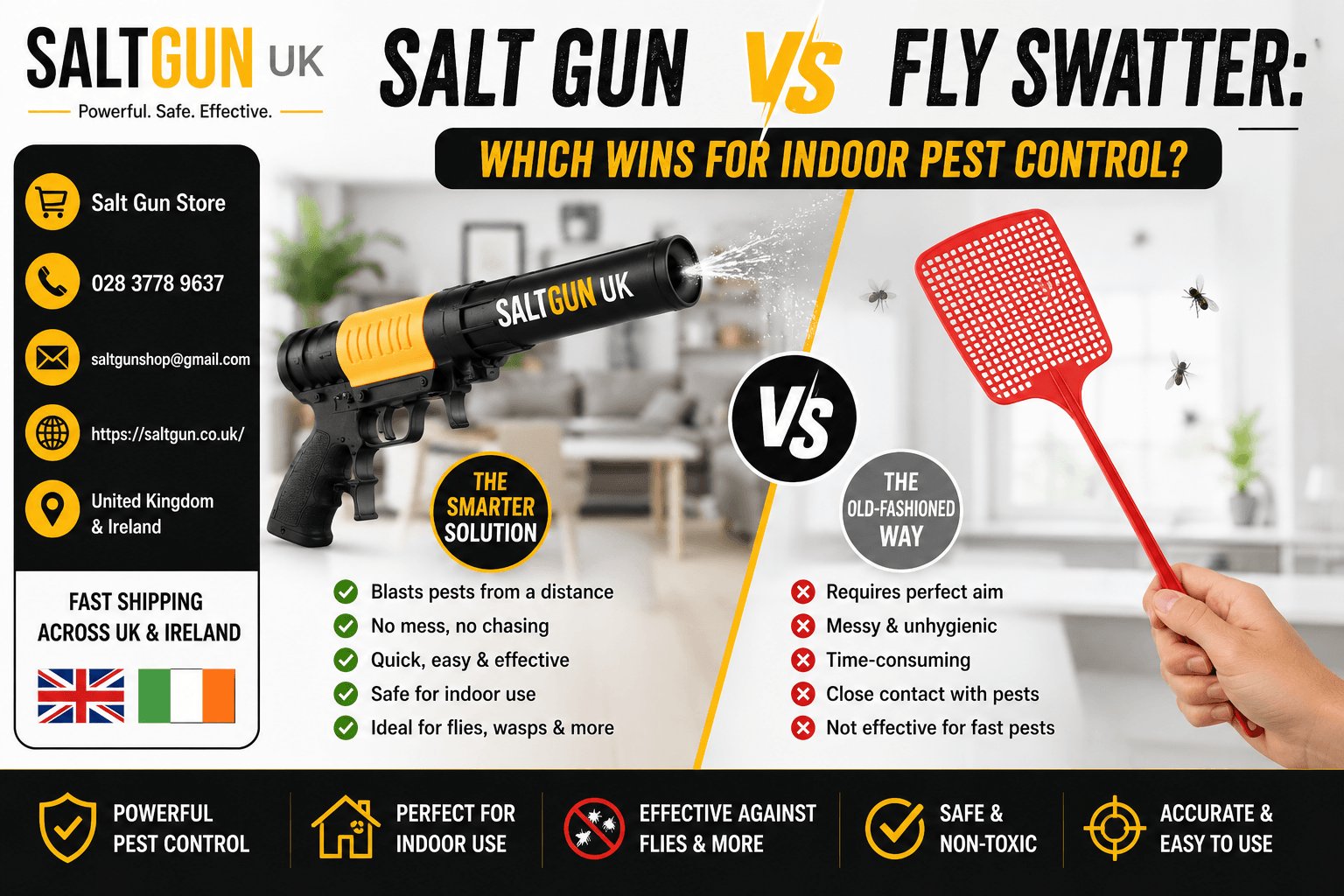
So which one actually wins when it comes to indoor pest control? Let’s compare the two head-to-head across the things that matter most: effectiveness, mess, effort, range, and overall experience.
Effectiveness: Accuracy vs Range
A fly swatter requires you to get close enough to strike directly, which means creeping up on a fly, judging its movement, and swinging fast enough to connect before it takes off again. Flies have incredibly quick reflexes, so a lot of swings end in failure — especially against smaller or faster-moving insects.
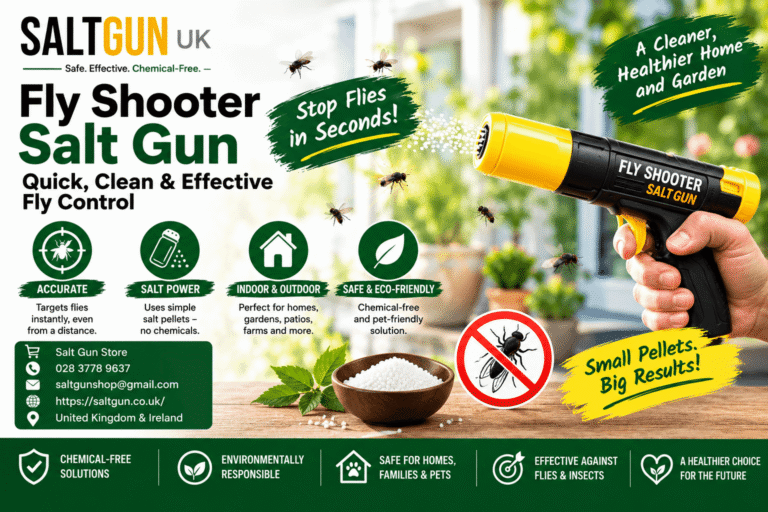
Salt guns take a different approach entirely. Rather than needing a single precise strike, they fire a cone-shaped burst of table salt that spreads out as it travels, similar to a shotgun blast. This means you don’t need pinpoint accuracy — as long as the fly is roughly in your line of fire within range, you’ve got a good chance of connecting. For many users, this makes salt guns noticeably more forgiving and effective for people who aren’t naturally quick with a swatter.
Mess and Cleanup
This is where the difference becomes really obvious. A fly swatter kills on direct contact, which often means a very visible (and not particularly pleasant) mark left behind on the wall, table, or wherever the fly met its end. Cleanup usually means wiping down the surface immediately.
A salt gun, on the other hand, uses the physical impact of salt granules to stun or kill the fly rather than crushing it against a surface. There’s no smear to wipe up — just a few grains of salt to sweep away, which is a far cleaner and more hygienic outcome, particularly in kitchens and dining areas where flies tend to gather.
Effort and Physical Demand
Swatting flies effectively takes a surprising amount of patience and precision. You need to track the fly’s movement, time your swing, and often make several attempts before landing a hit — which can be frustrating, especially with multiple flies buzzing around at once.
Salt guns simplify this considerably. Aiming and firing takes far less physical coordination than swinging a swatter accurately, and the spread pattern means near-misses can still land a hit. For anyone who’s ever chased a fly around a room with a swatter and come away empty-handed, this is a meaningful upgrade.
Range
A fly swatter has an obvious limitation: you need to be within arm’s reach (plus the length of the swatter) to make contact. This often means flies simply move out of range before you can strike, especially in larger rooms.
Salt guns offer a genuine range advantage, allowing you to target flies from a few feet away without needing to close the distance first. This makes it much easier to catch flies that have settled somewhere slightly out of easy reach, like a high shelf or the far side of a table.
Reusability and Running Costs
Both tools are reusable in the sense that neither is disposable, but the ongoing “running cost” differs. A fly swatter needs nothing beyond itself — no ammunition, no refills, just your aim.
A salt gun needs to be reloaded with ordinary table salt, which most households already have in the kitchen cupboard. This makes running costs essentially negligible, and there’s no need for special cartridges or replacement parts. Products from Salt Gun Store, for example, are designed to be reloaded easily and reused indefinitely with something as simple as everyday table salt.
Fun Factor
This is arguably where salt guns pull furthest ahead. Swatting a fly is, at best, a mildly satisfying chore. Firing a salt gun, on the other hand, has genuinely become something people enjoy doing — to the point where it’s turned pest control into an activity kids (and adults) actively want to take part in, rather than a task someone gets stuck doing reluctantly.
This shift matters more than it might seem. A pest control method that people are actually willing to use consistently is going to be more effective over time than one that gets left in a drawer because nobody wants to bother with it.
Safety Considerations
Both tools are generally very safe for indoor use, but they carry slightly different considerations. A fly swatter poses minimal risk beyond an accidental knock against a fragile object during a swing. A salt gun, while safe when used as intended, should never be aimed at people or pets, and should always be used the way it’s designed — loaded only with plain table salt, and not modified in any way.
Which One Should You Choose?
If you’re looking for the simplest, lowest-cost option and don’t mind the occasional missed swing (and the cleanup that comes with a direct hit), a traditional fly swatter still gets the job done.
But if you want something more effective at range, easier to use accurately, cleaner in terms of mess, and genuinely more enjoyable to actually pick up and use, a salt gun is the clear upgrade for most households — particularly kitchens, dining areas, and anywhere flies tend to be a recurring nuisance.
Final Thoughts
Both tools have their place, but for households dealing with regular fly problems, salt guns offer real advantages in range, cleanliness, and ease of use, without introducing any chemicals into the home. Salt Gun Store range of salt-powered fly killers is designed specifically for this kind of everyday indoor pest control, giving you a cleaner, more satisfying alternative to the classic swatter — with no smears left behind.
Whichever method you choose, the goal is the same: fewer flies, less hassle, and a home that stays comfortable through fly season.